Showing posts with label depression. Show all posts

Sunday, 29 September 2013

Suicide Rates Falling In Medical Marijuana States

“We conclude that the legalization of medical marijuana leads to an improvement in the psychological well being of young adult males, an improvement that is reflected in fewer suicides.”

This story didn’t make it past the network news filters, was ignored by the mainstream media, and numerous mental health/suicide prevention organizations would not even comment about it!
Wall Street Journal – Does Medical Marijuana Reduces Suicides? 

Why would a “good news” marijuana story, like where suicides markedly declined, be ignored by the media? Now some truth and daylight as reported by three American researchers who had their findings published by the Institute for the Study of Labor in Bonn, Germany. Why wouldn't it be published in the U.S.? Is it safe for a researcher and his or her future academic funding to challenge government dogma and publish contrary evidence domestically? Apparently it may not be, because it contradicts the misinformation and the socially engineered negative propaganda campaign against marijuana by self-serving interests since 1937. http://www.youtube.com/watch?v=MGZEMwMx2vk

 If the results of this study reported the opposite results, it would be the lead headline nationwide, I assure you. The emperor truly has no clothes!

• Marijuana improves the “psychological well being” of young adult males and saves lives!

• Marijuana’s major actions are that of an anti-depressant, anti-anxiety and anti-anger medication.

• Marijuana reduces alcohol consumption in this at risk population. ​

Can it to be used prevent suicide in a high-risk population? And what exactly is this state of “improved psychological well being?” It has been described and supported with evidence as the “cannabinoid homeostatic healing perspective” (CHHP) and the “psychology of optimal experience.” Marijuana’s therapeutic effect requires immediate further research, as the suicide study emphasizes. Do you really have to be sick to get benefit from cannabis? Isn’t relaxation itself medicinal?

 From: “High on Life? Medical Marijuana Laws and Suicide” / Jan 2012 (Anderson, Rees, Sabia)

 Abstract: Using state-level data (from Centers for Disease Control) for the period 1990 through 2007, we estimate the effect of legalizing medical marijuana on suicide rates. “There have been no previous attempts to estimate the effect of medical marijuana laws on completed suicides, the tenth leading cause of death in the United States.” (National Institute of Mental Health 2010) Data from states where medical marijuana is legal, looking back three years prior to legalization, the year of legalization (year zero) and three years’ post-legalization was compared against data on suicide rates in prohibition states.

“Our results suggest that the passage of a medical marijuana law is associated with an almost 5 percent reduction in the total suicide rate. “An 11 percent reduction in the suicide rate of 20- through 29-year-old males; and a 9 percent reduction in the suicide rate of 30- through 39-year-old males.” “We conclude that the legalization of medical marijuana leads to an improvement in the psychological well being of young adult males, an improvement that is reflected in fewer suicides.”


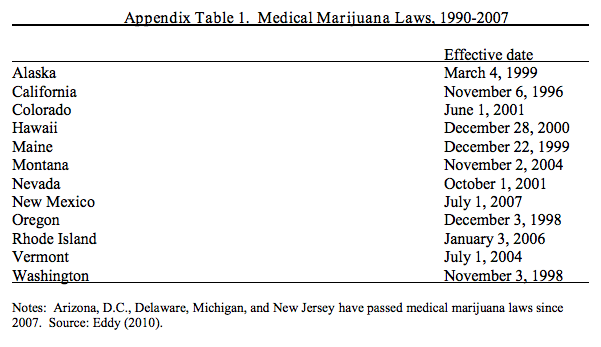


In an often-cited article by Hamermesh and Soss (1974), who were the first economists to model suicidal behavior, and according to their “economic theory of suicide,” negative shocks to happiness can reduce expected lifetime utility to the point where an individual will decide to take his or her own life,” overwhelming the individual’s ability to maintain homeostasis. “Even if a shock is perceived to be temporary, an individual with ‘time inconsistent preferences’ may commit suicide at the prospect of having to cope with an acutely painful state in the present.” “Consistent with the hypothesis that marijuana can be an effective treatment for depression and other mood disorders, there appears to be a decrease in the suicide rate of 15-19 year-old males in the treatment states as compared to the prohibition states for approximately two years after legalization.”

 “A similar decrease can be seen for males 20-59 and there is a moderate decrease in males 60 years or older three years after legalization.” In addition, this downward trend in suicides in states post-legalization was especially pronounced in males as was the risk of suicide by decreasing alcohol consumption. “The total suicide rate falls smoothly during the pre-legalization period in both MML (medical marijuana law) and non-MML states. “However, beginning in year zero, the trends diverge: the suicide rate in MML states continues to fall, while the suicide rate in states that never legalized medical marijuana begins to climb gradually.” http://blog.norml.org/2012/02/21/study-passage-of-medical-marijuana-laws-correlated-with-fewer-suicides/ 
The negative relationship between legalization and suicides among young adult males is consistent with the argument that marijuana can be used to cope with such shocks. However, estimates provide an alternative explanation. These authors found that the passage of MMLs (medical marijuana laws) led to sharp decreases in alcohol-related traffic fatalities, self-reported alcohol use, and per capita beer sales. The strong association between alcohol consumption and suicide-related outcomes found by previous researchers raises the possibility that medical marijuana laws reduce the risk of suicide by decreasing alcohol consumption.

​And in a very sad, related story that we all need to be mindful of: “More U.S. Soldiers Killed Themselves than Died in Combat in 2010” “For the second year in a row, more American soldiers — both enlisted men and women and veterans — committed suicide than were killed in the wars in Iraq and Afghanistan. Excluding accidents and illness, 462 soldiers died in combat, while 468 committed suicide. A difference of six isn’t vast by any means, but the symbolism is significant and troubling. In 2009, there were 381 suicides by military personnel, a number that also exceeded the number of combat deaths.” ​So, do you really have to be sick to benefit from cannabis? Isn’t relaxation itself medicinal?

The future is now! My last several posts have focused on evidence gathered over the last 10 years that shows marijuana can treat anxiety, depression, PTSD, and simultaneously increases subjective well being and positive states of cognitive, emotional and existential wellness. This study provides the numbers and stats to validate these claims. It provides evidence supporting marijuana’s positive psychology/happiness effects and the very topic of my recent post: marijuana and the psychology of optimal experience. When you ask people why they smoke marijuana, the most common answer is that it helps them relax and makes them feel better. That makes it medicine, and the word medical is redundant when talking about cannabis.

“Suicide is not chosen; it happens when pain exceeds resources for coping with pain.” Medical marijuana patients are able to reduce their use of painkillers, tranquilizers, and other psychiatric medicines! Isn’t it ironic that all antidepressants advertised on T.V. have increased suicide behavior as one of the many major side effects? Perhaps another variable at work here is that when people switch to safer marijuana to treat depression the prescription side effect of suicide goes away?

​SuicideNoteMarijuana restores homeostasis to the mind, similar to a period of mindfulness meditation or yoga. Marijuana reduces hostility, depression and anxiety, and blocks traumatic memories. Marijuana increases introspection, metacognition, calmness and laughter. Marijuana is unique among illegal drugs in its political symbolism, its safety, and its wide use. Smoking marijuana will never kill you; it is the antidote to modern life, it is medicine by popular vote! In 2007, the suicide rate was 11.26 per every 100,000 people. The population of the U.S. as of March 2, 2012 was 313,113,996. Approximately 35,250 suicide deaths occurred nationwide in 2007; a 5 percent decrease in suicide rate due to marijuana legalization would theoretically save almost 1,800 lives per year. The U.S. has been shoving our failed drug policy down the throats of countries around the world and and of citizens at home for decades. All of those in favor of a serious and honest debate say “Aye!”

Source: tokesignals.com

Thursday, 19 September 2013

Feeling Depressed, Stressed, Anxious or Tired? Meditation Can Help!


It is the year 2013 and many have complained that the world has become a densely populated stress ball! Finding time for ourselves is becoming harder and harder to achieve. Why not try a little meditation? Research has shown that even the busiest of us can reduce our stress levels and live a calmer, more focused life with the use of meditation.

We hear it all the time: Meditation can improve our creative thinking, our energy, stress levels and even our success. Prominent artists, businessmen and politicians cop to the practice. Would it work for you?

"It did to my mind what going to the gym did to my body -- it made it both stronger and more flexible," said Dr. Hedy Kober, a neuroscientist who who studies the effects of mindfulness meditation, which she has practiced for 10 years, at her lab at Yale University. She admitted during a TED Talk that she started meditating to deal with a break up, but found that it helped her handle stress and unpleasant feelings in all areas of her life.

Studies show that meditation is associated with improvement in a variety of psychological areas, including stress, anxiety, addiction, depression, eating disorders and cognitive function, among others. There's also research to suggest that meditation can reduce blood pressure, pain response, stress hormone levels and even cellular health. But what does it actually do to the body?

For one thing, it changes our brain. The cells and neurons in the brain are constantly making new connections and disrupting old ones based on response to stimuli, a quality that researchers call experience-based neuroplasticity. This affects the neural circuits of the brain, which in turn affects how we respond to situations. It also affects the actual structure of our brains -- thickening some areas and making others less dense.

"Think of the end of a neuron as a hand, with thousands of 'fingers,'" said Dr. Sara Lazar, a neuroscientist at Massachusetts General Hospital who studies mindfulness meditation. "The number of fingers relates to the number of interconnections between neurons and that number can change -- one reason it can change is due to stress."

Source: The Huffington Post


Wednesday, 21 August 2013

Signs & Symptoms of Gluten Intolerance


Could you be suffering from a gluten intolerance? Over 55 diseases have been linked to gluten (a protein found in wheat, rye, and barley, and in lower levels in spelt, kamut and oats), and around 99% of individuals suffering from gluten intolerances or celiac disease are never diagnosed. These individuals, unfortunately, fail to ascribe their ill health or symptoms to gluten sensitivity and instead try treating symptoms (with drugs) that otherwise never go away.

Gluten is a staple of the American diet. It is in pizza, pasta, bread, wraps, rolls, and pretty much all processed foods. It also causes serious health complications, with up to a 72% increased risk of death in those with gut inflammation related to gluten.

In fact, one study compared the blood of 10,000 people from 50 years ago to 10,000 people today and found that celiac disease rose by up to 400% during that time period. This is great news for the American healthcare system who claims millions of dollars off the drugs used to treat gluten-intolerance symptoms many individuals suffer from today.

The New England Journal of Medicine listed 55 “diseases” that can be caused by eating gluten. These include osteoporosis, irritable bowel disease, inflammatory bowel disease, anemia, cancer, fatigue, canker sores, and rheumatoid arthritis, lupus, multiple sclerosis, and almost all other autoimmune diseases. Gluten is also linked to psychiatric and neurological diseases, including anxiety, depression, schizophrenia, dementia, migraines, epilepsy, and neuropathy (nerve damage), as well as autism.

If you have any of the above diseases, or any of the symptoms listed below, you may have a gluten intolerance:

- Digestive Issues: gas, bloating, diarrhea, constipation
- Nutritional Deficiencies: due to malabsorption (e.g., suffering from anemia (iron malabsorption) or “chicken skin” on back of arms (result of fatty acid deficiency and vitamin A deficiency secondary to fat-malabsorption caused by gluten damaging the gut)
- Weight loss or weight gain: gluten protein disrupts metabolism functioning
- Fat in stools: gluten prevents fat absorption
- Aching joints: gluten triggers inflammation in the body, causing swelling and pain in your joints
- Depression: intestinal damage caused by wheat leads to malabsorption, and prevents our guts from absorbing zinc and B vitamins which are crucial for regulating our moods
- Eczema: related to the inflammation that gluten triggers in the body
- Headaches: inflammation from gluten puts a lot of pressure on our blood vessels, which can cause pounding headaches
- Exhaustion: gluten is incredibly hard to process by the body, and slows our digestion, thus making us tired
- Irritability & Behavioural changes: same as depression, our bodies cannot absorb minerals and vitamins when our gut is destroyed by the gluten we eat. These vitamins and minerals help regulate our mood
- Irregular menstruation, infertility, miscarriages: gluten intolerance creates imbalances to our hormones and can lead to a myriad of female fertility and menstruation issues
- Cramps, tingling, & numbness: triggered by inflammatory response the body has to gluten protein
- Slow infant and child growth: due to nutrient malabsorption
- Decline in dental health: gluten sticks to our teeth and this causes bacteria to thrive

Test yourself for gluten intolerance:
Eliminating gluten from your diet for a few weeks to a month is a great way to tell if your body has an issue with gluten. Gluten is a very large protein, so it is important to recognize that is may take months or years to clear from your system, so extending this gluten-free fast longer than a couple months before introducing it (if you so choose) is best.

If you feel much better off gluten than you do on gluten, then gluten is likely a problem for you. Eating a whole foods diet, high in raw fruit and vegetables will ensure the levels of gluten in your diet are significantly cut back.


Wednesday, 14 August 2013

How Dancing Improves Your Health

Like our new page on Facebook(Click Here) > The Natural Health Page

Do you enjoy dancing? Well you may be getting a variety of benefits you might not have otherwise known! There are numerous benefits to partaking in dance, whether it be by yourself, with a partner, or in a dance class. Not only does it increase your amount of daily exercise, but it also has incredible mental and emotional benefits as well!

The New England Journal of Medicine recently found that in elderly individuals, their risk of dementia was significantly reduced by over 76% simply by dancing frequently (compared to other activities, such as reading (35%), bicycling and swimming (0%), doing crossword puzzles at least four days a week (47%) or playing golf (0%)).

Why was dancing better than other activities for improving mental capabilities? Dancing often requires split-second rapid-fire decision making processes, and integrates several brain functions at once which increases the connectivity in the brain. Dancing simultaneously involves rational, kinesthetic, musical and emotional processes.

Dancing also helps with your flexibility, strength, endurance and overall sense of well-being! Dancers must strive to gain full range of motion for all the major muscle groups because with greater range of motion comes greater flexion and extension of the muscles. Many styles of dance also require jumping and leaping which require tremendous amount of muscle strength in major leg muscles. Endurance is the ability of muscles to work hard for longer periods of time without fatigue, and regular dancing helps improve your endurance (as with anything, such as running, walking, hiking, biking and swimming).

Dancing is effective in improving your self-esteem as well as reducing stress and depression. Emotionally, dancing improves self-awareness and self-confidence. It also can help strengthen the immune system through muscular action and physiological processes which can help prevent disease. Through dance, people can help identify and express their innermost emotions which creates a sense of renewal, unity and completeness.

Getting involved in dance is a great way to connect to mind, body and spirit. When I started dancing I felt at first, very sweaty and tired, but over time I became much more expressive in my dance. I got excited over the new moves and expressions I felt were a way of releasing tension, emotion and connecting to my inner self. It is incredibly fun and brings about an overall sense of happiness and bliss.

If you don’t know where to start dancing, you can turn on your favourite music and dance in your house, or you can even join a dance class locally or attend music festivals (which are rampant during summer). I am from Manitoba, so I will likely be checking out Folk Festival and the Manitoba Electronic Music Festival (MEME) which is the only annual event in Western Canada that highlights local and international electronic musicians at a free public venue. MEME is a festival that presents refined cutting edge electronic music performed using the latest in new creative technologies. MEME also features unique workshops for a full-day learning experience. If you live in the area (or anywhere for that matter), I highly suggest you come check it out!

For more information about this festival check out: http://www.memetic.ca


Sources: Live Love Fruit

Verghese, J., Lipton, R., Katz, M., Hall, C., Derby, C., Kuslansky, G., Ambrose, A., Sliwinski, M., & Buschke, H. (2003) Leisure activities and the risk of dementia in the elderly. The New England Journal of Medicine, 348, 2508-2516.

Jeong, Y., Hong, S., Lee, M., Park, M., Kim, Y., & Suh, C. (2005) Dance movement therapy improves emotional responses and modulates neurohormones in adolescents with mild depression. International Journal of Neuroscience, 115, 1711-1720.

Hopkins, D., Murrah, B., Hoeger, W., & Rhodes, C. (1990) Effect of low-impact aerobic dance on the functional fitness of elderly women. The Gerontologist, 30, 189-192.

Federici, A., Bellagamba, S., & Rocchi, M. (2005) Does dancing improve balance in adult and young old subjects? A pilot randomized controlled trial. Aging Clinical and Experimental Research, 17, 385-389.

Brown, S., Martinez, M., & Parsons, L. (2006) The neural basis of human dance. Cerebral Cortex, 16, 1157-1167.

Like our new page on Facebook(Click Here) > The Natural Health Page

Wednesday, 24 July 2013

Connecting With Nature Boosts Creativity and Health

Please like us on Facebook > The Natural Health Page

"I've been arguing for a while that connection to nature should be thought of as a human right," Richard Louv told the crowd assembled in the courtyard of National Geographic headquarters in Washington, D.C., on Wednesday. Louv was there to inspire the staff about the benefits of spending time outdoors.

Louv, the author of the bestsellers Last Child in the Woods (2005) and The Nature Principle (2011)-coined the term "nature-deficit disorder" to describe the loss of connection children increasingly feel with the natural world. Nature-deficit disorder is not a clinically recognized condition, he explains, but rather a term to evoke a loss of communion with other living things. Nevertheless, he argues, nature-deficit disorder affects "health, spiritual well-being, and many other areas, including [people's] ability to feel ultimately alive." (See "The Nature-Deficit Disorder and How It Is Impacting Our Natural World.")
The causes of the disorder include loss of open space, increasingly busy schedules, an emphasis on team sports over individualized play and exploration, competition from electronic media, and what Louv and others call a "culture of fear," in which people are afraid to visit natural areas or even go outside due to heavy media coverage of violent events.
To dive deeper into Louv's ideas, National Geographic sat down with him for a few questions.
It has been a few years since you published Last Child in the Woods in 2005. What has changed since then?
Quite a bit. I wrote another book, called The Nature Principle, extending the idea [of nature-deficit disorder] to adults. That's because I kept hearing from adults, who said, "It affects us too." At the time there were a lot of great people doing great work around nature, but in the media that issue was nowhere near the stove, let alone the front burner.
I didn't know it would have the impact it has. I never claim Last Child in the Woods started anything, but it proved to be a very useful tool, and things took off. Today, if you look at childrenandnature.org [the website of the Children & Nature Network, a group Louv founded], you'll see all kinds of good news from all over the country, and it's increasingly international. Nature preschools are beginning to take off. There are 112 regional, provincial, or state campaigns in the U.S. and Canada that are working on getting kids outdoors, many of which didn't exist before.
It doesn't seem to matter what someone's politics or religion is, they want to tell me about the treehouse they had as a kid, if they are old enough—for the younger people that is less likely to be true. This is the only issue I've seen that brings people together, because nobody wants to be in the last generation where it's considered normal for kids to go outdoors.
This week you spoke at an event with Sally Jewell, the U.S. Secretary of the Interior, at the Center for American Progress in Washington, on the importance of getting children and adults outside. How did that go?
Sally Jewell is a former head of REI, and she is one of the people who stepped forward when Last Child came out. She took an REI daypack filled with copies of the book, went to the White House, and handed them out to staff and the president.
She will be the third Secretary of the Interior in a row to be fully committed to this issue. The first was Dirk Kempthorne, a conservative Republican under President [George W.] Bush, who was very committed to this. So was Ken Salazar [under Obama], and now Sally, who probably has the most experience with this issue. [Tuesday's] event illustrates that this issue is growing.
Can you share some specific examples of how a connection to nature improved someone's life?
[National Geographic Emerging Explorer] Juan Martinez is one example. He grew up in South Central Los Angeles, where he was headed for gangs and trouble. A principal told him he'd have to go to detention or join the eco club. He thought the club sounded like a bunch of nerds, but he joined. He resented it at first, but then had an assignment to grow something.
He had seen his mother break up concrete behind their house to grow chilis to eat. So he grew a jalapeno chili plant and took it home to show her that he could nurture life too. That plant, and later an eco club trip to the Grand Tetons, changed his life. He is now an environmentalist and head of the Natural Leaders Network, which is part of the Children &  Nature Network. He is also a National Geographic explorer and has spoken at the White House twice.
So nature can transform your life. He found not only nature, he found people through nature. He reconnected to South Central in a new way. (See video of Juan Martinez.)
How can city dwellers connect with nature?
As of 2008 more people lived in cities than the countryside. That marked a huge moment in human history, and it means one of two things: Either the human connection to nature will continue to fade, or it means the beginning of a new kind of city.
One way is through "biophilic design" [nature-inspired design], which is the incorporation of nature where we live, work, learn, and play, not only as something we drive an hour to visit. Not only parks, but also in the way we design our neighborhoods, our backyards, and our buildings.
I believe cities can become engines of biodiversity. It starts with planting a lot of native plants, which revive the food chain and bring back butterfly and bird migration routes.
The word "sustainability" is problematic, because to most people it means stasis, survival, and energy efficiency. We have to do those things, but that only goes so far in igniting the imagination. Increasingly, I talk about a "nature-rich society," a different way to look at the future that is not just about survival, but about something much better.
How do we get to a greener future?
I visited the Martin Luther King memorial yesterday. King demonstrated and said that any movement will fail if it can't paint a picture of a world people will want to go to. That world has to be more than energy efficient, it must be a better civilization.
I think we're in a cultural depression. The number one young adult literature genre today is something called dystopic fiction, which portrays a post-apocalyptic world in which vampires aren't even having a good time. I have a theory that most Americans carry images of the far future that look a lot likeBlade Runner and Mad Max. If those are the dominating images, and we don't have a balancing set of images of a great future, then we better be careful what we imagine.
You have written about the impacts of "nature time" on problems like anxiety, depression, ADD, and obesity. How important is that?
If you look at a new body of research on depression, ADD, physical health, child obesity, and the epidemic of inactivity, nature is a good antidote to all of that. I didn't coin it, but I like the phrase "sitting is the new smoking," because new evidence shows that sitting long hours every day can have serious health risks similar to those caused by smoking.
Researchers at the University of Illinois are investigating whether time in the woods could be used to supplement treatment of ADD. A study at the University of Kansas found that young people who backpacked for three days showed higher creativity and cognitive abilities. People in hospitals who can see a natural landscape have been shown to get better faster.
As an antidote, we need to figure out ways to increase nature time even as technology increases. It has to be a conscious decision.
Speaking of technology, how much are "screens" like TV, the Internet, video games, and smartphones to blame for keeping kids indoors?
I always resist demonizing technology and video games, specifically, partly because when people write about this issue they go immediately to that. But then they ignore these other things, like "stranger danger" [Louv has argued that sensationalist media has made parents fearful of letting children go outside] and bad urban design, the fact that our education system needs a lot of work, the fact that we are canceling recess and field trips—there are a lot of other reasons out there.
Having said that, there's no doubt that electronics have something to do with this. The Kaiser Foundation found that kids spend 53 hours a week plugged in to some kind of electronic medium, and I imagine that's true of adults too. I have an iPhone and iPad, I spend a lot of time with screens, but I think the more high-tech our lives become, the more nature we need as a balancing agent.
How can parents know if their kids might suffer from nature-deficit disorder? Are there warning signs?
I don't think this is something that can be reduced to individual symptoms in individual children. I've always felt it was a more generalized issue, a disorder of society that has implications for all of us.

This interview has been edited and condensed.
Sources: Higher Health